
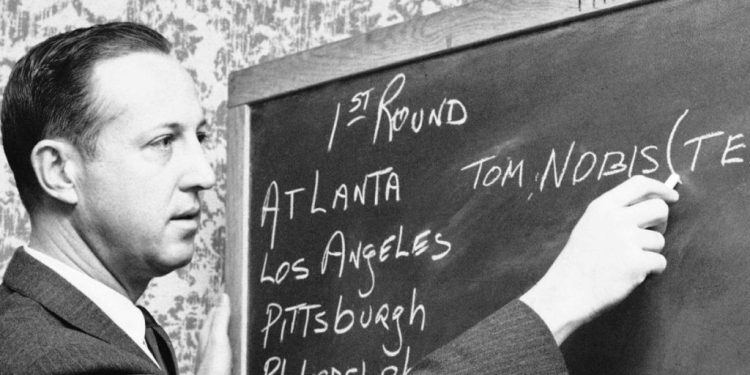
The NFL is the master of Marketing. For decades the Draft was a cozy business day in a downtown hotel Ballroom. Now it’s a 3-day event in front of throngs of people and a national TV and streaming audience on any number of platforms. It’s gone from being a minor expense to the League to now being a monster money-maker. It’s the NFL’s version of Alchemy; making Gold out of Lead. The League simply defies the gravity that bounds normal business.
This year’s mega-event is in Pittsburgh starting at 8 p.m. EDT today. That much we know. Nearly everything else about this Draft is a set of question marks. One notable exception is the identity of the #1 pick. The Raiders will select Fernando Mendoza, Quarterback out of Indiana. After that, it’s a craps shoot. Washington arrives as a team in need of more pieces/parts than it can snag in three-days. And, it burned some of its powder acquiring stud Left Tackle Laremy Tunsil. The franchise only has 5-selections with a threadbare 2-selections in the Top-100. There is much to discuss below.
The Board
Each Draft has its own personality. 2024 is memorable as the Draft of the Quarterbacks. Six were taken in the first twelve picks. There may not be six taken during the entire Draft this year. And, there certainly won’t be more than two taken in the first-round. Quarterbacks get “Over-Drafted.” In a QB-driven League not having a proficient QB is a deficiency that can’t be overcome. For those of you who are Baseball fans think of Draft Picks as At-Bats. The Batting Average on QBs is pretty dismal. For First-Round picks the average is less successful than perceived.
The fuel that fires the engines of teams within the hard salary cap is the Rookie contract. There the value of the contract is slotted according to when the player is Drafted. The #1 selection will make approximately $60-million over the four-year span. Dak Prescott makes that every year. The Franchise Tag value of a QB is $43.9-Million for a single season. The Raiders will realize what’s called “Surplus Value” of ~$28-Million for each of Mendoza’a first four years. Players drafted in the first-round can also receive a Club Option for the fifth-year. There are steps in the payment scheme to reward sufficient playing time, 1 Pro-Bowl appearance, and more than one Pro Bowl. The compensation for the multiple Pro-Bowlers is the same as a Franchise Tag value for the position. For the other categories the pay is cut substantially. Teams have to decide on the Fifth-year option after the third-year. For Jayden Daniels the decision comes about a year from now.
The fifth-year option is a bit of a “Tell” on how successful the Draft went. Often teams will exercise it only as a way to open contract extension talks. Will Anderson was tagged by Houston this year. A few days ago he signed a monster extension. He was one of only ten players to get the option. That’s about average. One-third of the first-round is deemed worthy of the option. Typically it’s all players taken before #20. The 2023 class is unusual in that 4 of the 10-players came after #20. But, they are all at the lower end of the pay scheme. Players with multiple Pro Bowls, there were four of them all signed contracts before the option was issued. So, it’s not a precise barometer. Still, there are guys like Emmanuel Forbes on that first-round list. Swings and misses happen more often than one would think.
About that Surplus Value
What makes this Draft Board so funky is that the top players are not at the “Premium Positions.” In this case “Premium” means “Expensive.” One one side of the desk is this list of Franchise Tag values:
Quarterback: $43.895 million
Wide Receiver: $27.298 million
Defensive Tackle: $27.127 million
Linebacker: $26.865 million
Offensive Line: $25.773 million
Defensive End: $24.434 million
Cornerback: $21.161 million
Safety: $20.149 million
Tight End: $15.045 million
Running Back: $14.293 million
Kicker/Punter: $6.649 million
Note that some who cover the League use the Highest Contract player to assign Surplus Value. A Franchise Tag Defensive End carries a $24-Million tag. But, Miles Garrett makes $42.5-Million. It makes the numbers look more impressive, but is basically hokum.
On the other side of the Ledger is the slot value of the Rookie Contract. As discussed the slot value of the #1 Pick is ~$15-Million AAV. For #5 the value is ~$10-Million AAV. For the #10 pick the value is ~$7.5-Million AAV. This trend continues to where the #32-pick is ~4-Million AAV.
There are a large number of folks dedicated to analyzing College Players for the Draft. Dane Brugler of THE ATHLETIC is one of the best. In his Top-Ten athletes list he has 1-QB, 3-DEs, 1-WR, 1-Safety, 1-LB, 1-Corner, 1-Running Back, and 1-OT. Only six of these are at so-called Premium positions. Nearly every mock draft has three of them gone in the first 4-picks. Washington picking at #7 will be left to choose between, maybe, a Corner, a Running Back, a Linebacker, or the last Edge in the top-ten. From a Surplus Value standpoint this is a bitter pill. At that slot an Edge would produce about $15-Million AAV in Surplus Value. For the Running Back it would only be about $5-Million. If Adam Peters is playing the Surplus Value game the pick would be Ruben Bain, the #3 Edge in the pool.
There are forceful arguments out there that neither the Safety, Running Back, or Linebacker should go inside the Top-10 based on this line of reasoning. Dismiss it if you will. But, in the last three-Drafts only two players were taken in the Top-10 at non-premium positions. And, for those hoping for Trade-Down scenarios this rationale hurts the chances to find a dance partner. At the end of the day Adam Peters may defy all of this and take the Running Back if he’s still on the Board. We just don’t know.
Of Warts and Short Arms
One of the problems with the Draft is that it doesn’t happen sooner. With the end of College ball in January the window for constructing a Draft Board is too large. The temptation of over-think everything is irresistible. Forget that Scouts have been following the players all season. Forget the endless hours of tape on hand. Rather, put the candidates in basketball uniforms and have them run around at the combine. The “Underwear Olympics” shape Drafts in a disproportionate way. The old adage is that the “Tape doesn’t lie.” But, it gets short shrift if the player can run a 4.3-second 40-yard dash.
We’ll get to a few prospects in a bit. But, if Sonny Styles is the apple of your eye then realize that his Combine numbers drove a serious climb up the totem pole. The tape is ok. But, this guy’s speed and agility were off the charts. Does that translate to success in the NFL? Not always. in 2021 Ron Rivera picked Jamin Davis out of Kentucky. Freakish athletic ability was not the question. He was a stunning athlete. But, NFL success has yet to materialize. After five-seasons it most likely will not.
Other metrics are garnered during the Combine. One is actual physical measurements. The Colleges are misinformation factories for the attributes of their players. Every year players arrive at the Combine then suddenly grow a few inches shorter. It’s a given. Ruben Bain’s arms measured out to 30 & 7/8″. That’s short. It was short enough to knock him down the rankings list from top-3 to somewhere lower. This is a player who was tremendous in college. And, he could well be a “3-Technique” (Lined up on the shoulder of a Guard with his hand on the dirt.) But, the arms length became a serious concern. Guards lock in with their hands. With the shorter arms the thinking is that the Guard will usually win because they’ll get the grip first. Bain may end up being a Hall-of-Famer. But, his arm length will cost him some money in the near term.
Then the background stuff comes out. Bain was involved in a fatal car accident, but was not charged. Is that a disqualifier? It wasn’t for Jalen Carter with the Eagles.
The list of warts on players grows as the Draft nears. Teams leak information that will drive a player down the board. Then the hope is that he drops all the way to where they are waiting. Safety Caleb Downs, the heralded next coming of Kyle Hamilton supposedly has a knee issue that is “Degenerative.” If that word doesn’t give rise to pause few things will. But, is it real?
Adam Peters said it succinctly: “Right now everyone is lying.”
Stay or Trade?
Before touching this subject remember one thing: A trade-down is not a unilateral action. Some other team has to want your Draft slot to take a player they deem worth the premium.
Washington desperately needs more picks. Five won’t do it. The most valuable is that #7. But, what player will be there that some other team wants badly enough to trade up for it? If you have stared at more mock Drafts than is conducive for mental health the likely suspects are Monsoor Delane, the Shutdown Corner from LSU; Carnell Tate, the Wide Receiver from Ohio State; Ruben Bain, Edge; Sonny Styles, LB from Ohio State; and, Caleb Downs, Safety from Ohio State. Most of the mocks have Jeremiah Love, RB from Notre Dame as long gone at #7. Don’t bet on it. In the last 10-Drafts there have been only 5-RBs taken in the top-10 selections. Saquon Barkley went at #2. Leonard Fournette went at #4. The other three, including Christian McCaffrey went below #6. Love could be there. And, that might just be enough bait to swing a deal.
Of course, one would hate to pass on a potential Gold Jacket player. That’s the rub.
The Analytics folks say to trade down if you can. Dan Snyder hired a small firm that did analysis on Drafts. Their conclusion was expensively purchased common sense. If a Draft selection is an At-Bat with swings, misses, and hits then the more ABs you get the more hits you’ll have. Snyder, as he was wont to do, overrode his football people and the consultants by trading up. When the consultants asked for an explanation it came without hesitation: “Mr. Snyder wants to win now.”
The Search for Tea Leaves
Adam Peters has already brought something to Ashburn that was not there before: Operational Security. That building is as tight as a drum. Whatever he has in mind is within the walls. So we are left to anticipate his moves based on essentially nothing. The media has gone scrambling for clues. One of them is the RAS: Relative Athletic Score. This is a composite of various numbers from the Combine.
If one looks closely then Peters’ draft selection have all had high scores. His Free Agent signing of Leo Chenal also has RAS connections. Chenal had one of the highest RAS scores ever for a Linebacker. One of nature’ laws is that a vacuum wants desperately to be filled. The media is only too happy to fill in the silence from Ashburn. In the media world correlation and causation are a unity. Ergo, we can assume that Mr. Peters will take the highest RAS guy available. One long screed even stated that because player X skipped a measurement at the Combine his RAS score is incomplete making him un-draftable by Washington. As silly as that sounds it’s not near the top of the list of silliness out and about over the past month.
Maybe the GM is trying to get an athletic, fast, and younger team on the field. Regardless, look for some noise post-Draft corelating RAS and the WFT’s Draft selections.
It is Here
The great news is that the Draft is here putting a merciful end to the speculation. Next will come the “Grades.” Oy! But, the larger picture is that this Draft is a key for Washington. The team MUST come out of this with a viable WR2 to complement Terry McLaurin. If not, then a Free Agent signing is a given. Washington SHOULD draft a Center. There are a number of them out there on the Board. Adam Peters SHOULD draft a Corner.
A move down that gives them access to the Round-2 Wide Receivers makes a lot of sense. Drafting Carnell Tate in the First Round makes a lot of sense. This list of “…makes sense” is exceedingly long. But, at the end of the day it’s only what makes sense to Adam Peters that matters.
Draft Times and Coverage
- Thursday, April 23: Round 1, 8 p.m. ET
- Friday, April 24: Rounds 2-3, 7 p.m. ET
- Saturday, April 25: Rounds 4-7, Noon ET
NFL Network, NFL+, ESPN, ESPN2, ESPN Deportes
